Why Employees Get More Engagement Than Company LinkedIn Pages
TLDR: 3 Takeaways from this Post:
Your company page won't be your growth engine. Its job is to establish credibility, while your experts build trust and reputation.
Don't turn every consultant into a thought leader. Build a reputation team with clear roles for thought leaders, contributors, amplifiers, and the company page.
Design for reach, not just content creation. Create simple systems that make it easy for employees to share ideas, amplify expertise, and extend your firm's visibility beyond the company page.
Your company page isn't underperforming. It's being asked to do a job it was never designed to do.
Professional services firms have a unique LinkedIn challenge: the product is the people.
The same expertise that creates value for clients is also what attracts attention on LinkedIn.
Your company publishes an announcement, article, or conference update and hears crickets. A few likes. No shares. No comments.
Then one of your consultants posts a similar observation and engagement is in the triple or quadruple digits.
You may be tempted to fix this by focusing on the corporate content itself. Maybe the post wasn't interesting enough. Maybe the company needs to post more often. Maybe the algorithm changed. Maybe you should focus on more videos or carousels.
But format, pillars, and frequency are usually not the problem.
The real issue is that most professional services firms use LinkedIn as a publishing platform when it functions more like a reputation network.
People aren't curious about your brand. They're curious about your experts. They want to understand how experts think, how they solve problems, and what they're seeing in the market. Individual consultants naturally provide that context in a way that company pages usually can’t.
The shift is to recognize that the company page, thought leaders, and the broader team each have different jobs.
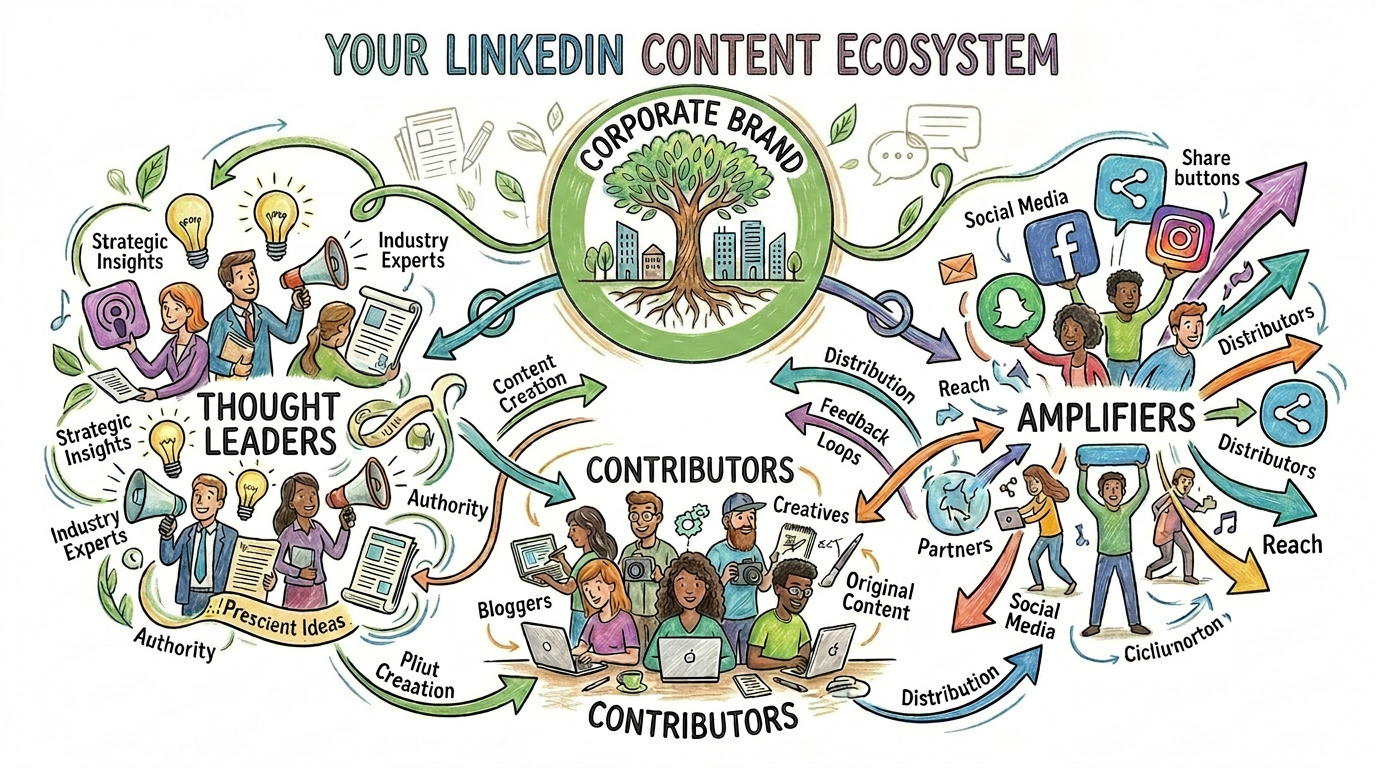
I had fun making this image with Adobe Firefly. I’m not sure what Pliut Creaation or Cicliunorton is, but I’m rolling with it.
Your Company Page Is Not Your Growth Engine
Your company page will not carry the weight of business development and growth.
Think of it as the institutional voice of the organization. Its job is to make your expertise visible and credible. It demonstrates that your firm is real, established, growing, and relevant. It proves that your ideas, experience, and point of view are backed by an organization that can deliver results.
This is especially important for smaller firms. Everyone knows what Deloitte stands for. But prospects may have no idea what your mid-sized niche consultancy stands for.
The company page helps answer that question.
People Build Reputation. Reputation Fuels Opportunity.
While company pages establish credibility, people build trust.
When buyers evaluate a consulting firm, they want to know:
Who will I be working with?
How do they think?
Do they understand my challenges?
Have they solved problems like mine before?
Individual consultants answer those questions better than corporate accounts can. This is why employee posts outperform company content.
And that's a good thing.
The company builds authority. The consultants build trust. Together, they build reputation. Reputation drives inquiries and referrals.
Build a Reputation Team, Not a Content Team
Once leaders understand that LinkedIn is a reputation system, the question changes.
Instead of asking: "How do we get everyone posting?", ask: "How do we stop relying on the company page to carry the entire brand?"
Most firms approach LinkedIn as a content production challenge. It's actually an organizational challenge. The strongest programs create clear roles.
The Company Page: Provides institutional credibility and visibility for the firm's expertise.
Thought Leaders: Share ideas, perspectives, and observations publicly. They become the visible experts associated with the firm's expertise.
Contributors: Supply stories, client questions, examples, and market intelligence that strengthen those ideas.
Amplifiers: Comment on, share, and introduce ideas to their own networks, helping expertise travel further than it otherwise would.
The goal is not to turn every consultant into a creator. It's to distribute visibility across the organization instead of relying on one source.
What If They Leave?
When I suggest investing in the reputations of a selected group of consultants, someone inevitably asks: "What if we help our consultants build visibility, and then they leave?"
Fair question.
But it focuses on the wrong risk. The bigger risk is building a firm where all visibility belongs to the founder, or no one at all.
Expertise only creates opportunity when the market knows it exists.
Firms that encourage experts to participate create a deeper bench of visible talent. They become known for a community of expertise rather than a single personality. That's a stronger foundation for long-term growth and worth the risk that someone may eventually move on.
Make It Easy to Amplify Your Ideas
Once you've identified your thought leaders and contributors, you need systems that help expertise spread.
One simple example is creating a dedicated Slack or Teams channel where employees share new LinkedIn posts, published articles, speaking engagements, media mentions, and company announcements.
If you have an internal newsletter, include links and updates there as well.
The goal is not to increase impressions. It's to create habits of participation. You want it to be normal for consultants to share valuable ideas with their networks. Make it easy. Make it visible. Make it routine. Make it fun, even.
A consultant comments with an example from a recent client engagement. Another shares a perspective from an industry conference. A third introduces the post to someone in their network who would find it useful.
The goal isn't more content. It's more conversation.
The Real Opportunity
The answer to your LinkedIn problem is not more content, formats, or posting frequency. It's creating a powerful connection between institutional expertise and individual credibility.
The company owns the ideas.
The consultants bring those ideas to life.
Contributors strengthen those ideas with real-world experience.
Amplifiers help those ideas travel.
Together, they create something more memorable than a company page or a collection of personal brands - They create a reputation ecosystem.
When this system works, expertise becomes visible, shareable, and part of the growth engine.
Most professional services firms are sitting on far more expertise than the market ever sees. The firms that win aren't necessarily the smartest. They're the ones that make it easy for prospects, partners, and referral sources to see the expertise they already have.
That's the real opportunity, both on LinkedIn, and for the business as a whole.
How is your firm using LinkedIn today? If you are struggling to build visibility, don’t start by asking what to post. Ask whether the right people are visible.
Keep Reading